

In Part 2, Arjuna's understanding deepens as Krishna reveals the broader nature of reality, the importance of legacy, the power of wholehearted commitment, and ultimately grants Arjuna a transformative vision of the cosmic order.
This is Part 2 of a 3-part series:
- Part 1: Foundation (Chapters 1-6)
- Part 2: Development (Chapters 7-12) – You are here
- Part 3: Culmination (Chapters 13-18)
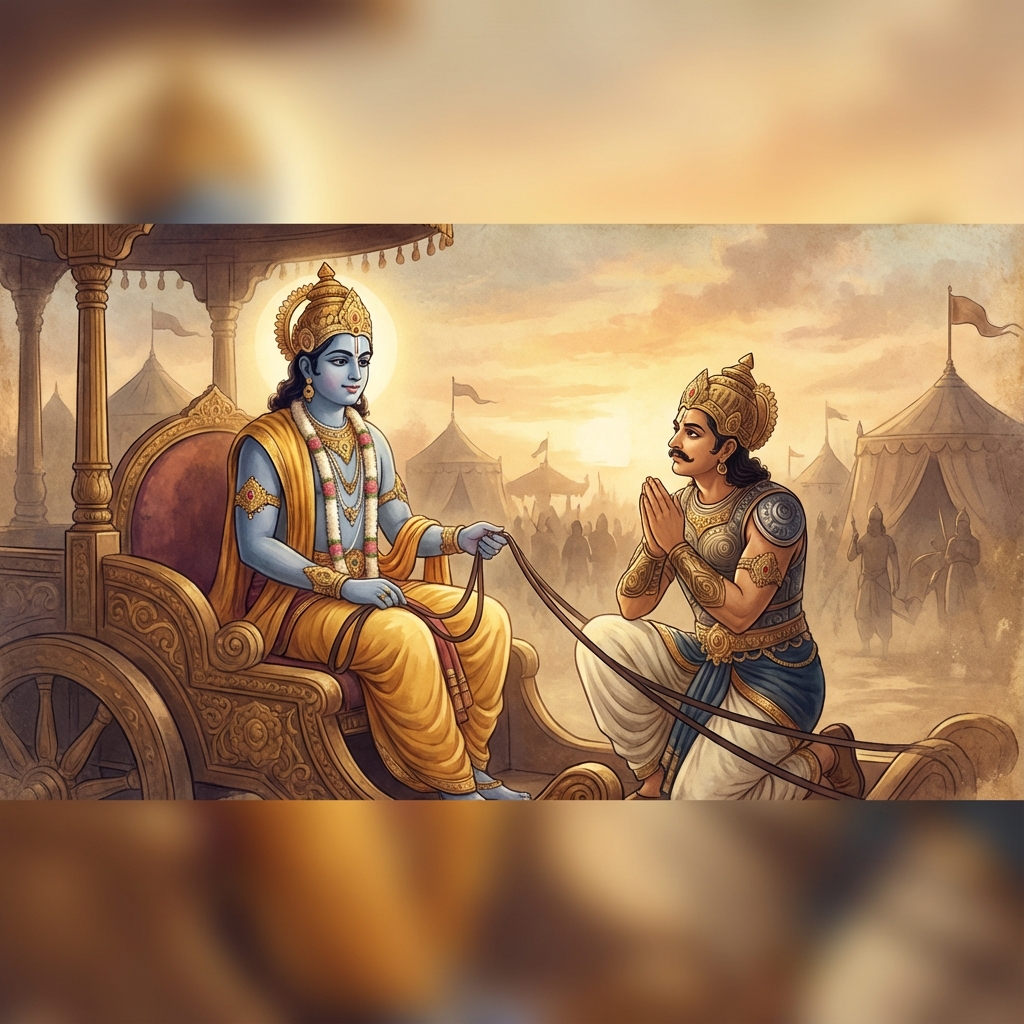
Chapter 7: Broadening Vision – Understanding the Reality of Life
Having addressed personal conduct and mindset, Krishna's teaching shifts to a grander philosophical perspective. Arjuna is invited to understand the nature of reality from the perspective of his inner wisdom. This chapter zooms out from the individual to the universe, giving Arjuna (and us) a sense of the "big picture."
Krishna begins by speaking of the fundamental makeup of the world – earth, water, fire, air, space – and adds mind, intellect, and ego as constituents of reality. We can interpret this as an ancient attempt to describe everything that exists, both physical and psychological.
Krishna then makes a profound statement: behind all these facets of reality lies a unifying essence. To illustrate, he gives poetic examples: "I am the taste in water, the light of the sun, the sound in air, the life in all beings, the intelligence of the intelligent." This suggests that whenever we observe something truly wondrous or essential, we are encountering an aspect of the same fundamental reality.
In a psychological sense, Arjuna is being trained to see the good and the noble everywhere. This can be likened to developing a sense of awe and connection. Modern thinkers often say that understanding the cosmos scientifically can inspire a spiritual feeling even in atheists. Here, Krishna encourages a kind of secular devotion to the marvels of reality.
Krishna also warns about common pitfalls: many are lost in material desires or clinging to limited understandings. The antidote is to cultivate curiosity and humility – to look beyond surface glitter and yearn to understand deeper connections.
Insight: Lift your gaze to the bigger picture. Recognize the underlying unity and order in the world – the common threads of truth, goodness, and beauty that run through everything. When you align your actions with those enduring values, you tap into a source of strength much greater than your ego.
Chapter 8: The Imperishable Goal – Reflections on Mortality and Legacy
Arjuna now asks Krishna heavy questions about life and death. Chapter 8 dives into the ultimate purpose of life, what happens when we die, and how to face mortality with wisdom. We can draw out a powerful secular message about focusing on what is imperishable – what truly lasts – amidst a transient world.
Krishna explains the concept of the imperishable reality. Secularly, think of it as the highest truth or ultimate value that doesn't fade away. Physical bodies perish, wealth and fame come and go, even civilizations rise and fall – but certain things are timeless: the impact of genuine goodness, the truth of scientific principles, the memory of noble deeds. We might call it legacy or timeless values.
Arjuna wonders how one's mindset at death affects them. Krishna's reply: "Whoever remembers the highest reality at the time of death attains it." This suggests that how we face our death reflects how we lived our life. Modern psychology finds that people near the end of life often find peace if they feel their life had meaning. Regrets usually come from deviating from one's values.
Krishna instructs Arjuna to always keep his highest ideal in mind, not just at death but throughout life. By constantly remembering why he is doing what he's doing, Arjuna's actions become aligned and purposeful. Even when things are confusing or dangerous, that guiding star helps navigate.
Insight: Remember that life is finite. Instead of this truth causing despair, let it sharpen your focus on what truly endures. Identify the values or goals that outlive fleeting pleasures. Live oriented toward those ideals, and when the time comes to face your mortality, you can do so with peace.
Chapter 9: Devotion to an Ideal – The Power of Wholehearted Commitment
In Chapter 9, Krishna speaks of a "royal secret" or supreme knowledge. In non-theistic terms, this chapter is about the transformative power of devotion – not to a deity, but to one's highest ideal or purpose.
Krishna describes how those who wholeheartedly commit themselves to a noble cause are protected and uplifted by that very commitment. It's almost as if when you truly dedicate yourself to something greater than yourself, your own full energies marshal together, and you find support in unexpected ways.
Krishna says, "Whatever you do, do it as an offering to that higher purpose." For Arjuna, every act on the battlefield – every decision, every arrow released – he performs not out of anger or ego, but as service to the moral order. For us, this might translate to integrating our values into every action. This mindset gives a profound unity to life – no action is "meaningless."
Krishna also speaks about inclusivity: even those who have made mistakes, if they turn wholeheartedly toward a good path, should be seen as noble. "Even a person of misdeeds, if he dedicates himself to a higher ideal, must be considered virtuous, for he has made a resolute decision." This is a powerful statement of redemption and human potential.
By the end of Chapter 9, Arjuna is encouraged to surrender his worries and simply love the good for its own sake. Make your cause your beloved – this loving focus simplifies many decisions and provides emotional fulfillment.
Insight: Dedicating yourself wholeheartedly to a noble purpose unleashes tremendous strength and peace. When you treat your work and actions as offerings to your highest ideal, you align your whole being toward what matters. No matter your past, you can choose now to devote yourself to something good.
Chapter 10: Finding Inspiration – Seeing the Great in the Ordinary
In this chapter, Krishna speaks poetically, listing how the greatest of each category in the world can be seen as a reflection of the divine. Secularly, we can interpret this as a guide for finding inspiration and reminders of our ideals everywhere around us.
Krishna essentially says: "If you want to remember what your inner wisdom stands for, look at the most splendid things in life – the brightest star, the noblest animal, the wisest person – and see those as examples of that greatness." Think of the sun – its light enables all life; that's like truth. Think of a lion – king of animals – that's like courage. Think of a high mountain – steadfast and towering – that's like unshakable principle.
By contemplating these analogies, Arjuna can fuel his motivation. They are mental images to bolster his resolve: whenever he sees something awe-inspiring, he can remind himself of the values he's fighting for.
Krishna's enumeration also teaches humility and wonder. The world is full of astonishing things not made by Arjuna or any single person. By appreciating that greatness, Arjuna keeps his ego in check. He realizes he's part of a larger tapestry of excellence and power.
Another point is finding the extraordinary within the ordinary. Even in daily life, one can notice small instances of greatness: the compassion of a nurse, the integrity of an honest shopkeeper, the curiosity of a child. These are all reflections of the values we cherish. This prevents cynicism.
Insight: The world around you can serve as a source of strength if you choose to see it that way. Find role models and symbols in nature, history, or daily life that remind you of your highest values. Cultivate awe and appreciation – it keeps you humble and deeply motivated.
Chapter 11: The Overwhelming Vision – Confronting the Full Reality
This chapter is the dramatic climax of the Gita. Krishna grants Arjuna a direct vision of his "universal form" – a terrifying and majestic image of the entire cosmos and the relentless flow of time. In our secular narrative, this is Arjuna experiencing a profound epiphany – a moment of overwhelming clarity where he truly comprehends the enormity of reality.
Imagine Arjuna suddenly having something akin to a panoramic, time-lapse vision. In an instant, he perceives all the forces at play: the countless lives involved, the wheels of fate turning, and death sweeping through the battlefield like an all-devouring force. He sees Time personified consuming everything. It is as if "I have become Death, the destroyer of worlds" stands personified before him – a stark encounter with mortality.
What does this do to Arjuna? First, it shatters any remaining illusions. If some part of him still clung to the hope that maybe no one needed to die or that he could avoid this conflict, that part is gone. He sees that change and destruction are part of life. This is terrifying, but it also liberates him from the paralyzing fear of causing what is, in the end, unavoidable.
Second, it humbles Arjuna completely. Facing the sheer scale of the universe, Arjuna realizes how small he is. His ego is utterly dissolved in that moment of awe. He feels both insignificant and yet deeply connected to the whole.
Krishna's voice within this vision reassures: "All these warriors are already slain by their own deeds and by time; you, Arjuna, are merely an instrument of destiny." Arjuna's duty is to do his part as best as he can, and not arrogantly think he can control the larger fate.
When the vision ends, Arjuna is trembling. He asks Krishna to return to his familiar human form. The cosmic perspective, while enlightening, was too intense to live in constantly. The effect is transformative: Arjuna now understands viscerally what he intellectually accepted earlier. After this, Arjuna's last traces of doubt are gone.
Insight: Sometimes we need a jolting confrontation with reality – an epiphany of how large, complex, and uncontrollable the world really is – to put our role in perspective. By facing the facts of mortality and the vast forces of life, we can move beyond paralyzing fear. We see that our ego was never truly in control – we're part of a greater flow.
Chapter 12: Love and Service – The Path of Devotion in Daily Life
After witnessing the cosmic form, Arjuna's trust in his inner guide is absolute. He now inquires about the best way to practice this connection in life. Chapter 12 distills this into simple terms of devotion, character, and practice.
Krishna's answer favors devotion to a personal form as easier for most people than abstract meditation on the formless. Interpreted non-religiously, this means it's generally more effective to personify or concretize your ideals. Humans benefit from relatable focus.
Krishna beautifully describes the qualities of a person who truly loves their ideal:
- Friendly and compassionate to all
- Free of ego – not arrogant or proud
- Even-minded in pleasure and pain
- Forgiving and content with whatever comes
- Self-disciplined and determined, yet without stubborn attachment
Krishna lists a number of virtues: tolerance, simplicity, self-restraint, fearlessness, etc. For Arjuna, this list is like a code of conduct. It paints a picture of an ideal human being – psychologically balanced, ethical, and full of goodwill.
What's important is that this is no longer about grand philosophy, but about everyday behavior and attitude. After all the high drama, Krishna is grounding Arjuna back in the real world by saying: just be a good person – kind, brave, selfless – that is the highest way to honor truth.
Krishna also offers a descending ladder of options: if you can't constantly keep your mind on higher truths, then practice by regular exercises. If that's too hard, just do your work diligently and ethically. And if even that is hard, just perform acts of kindness whenever you can. This is encouraging: you don't have to be a monk or a genius to live a life of value.
Insight: At the end of the day, what matters is living with heart. Attach your heart to the highest ideals you admire and let that love guide how you treat others. Cultivate virtues like kindness, humility, and resilience. There are many ways to progress: whether through meditation, dedicated work, or simple acts of kindness, what counts is the sincerity and love you put into it.
Continue Reading
This concludes Part 2 of our secular interpretation of the Bhagavad Gita. Arjuna has experienced the overwhelming vision and now understands the path of devoted, loving service.
Previous: ← Part 1: Foundation (Chapters 1-6)
Next: Part 3: Culmination (Chapters 13-18) →
In Part 3, we explore self-knowledge, the three qualities of behavior, cutting through illusion, virtue vs vice, and Arjuna's final resolve.
This is part of my philosophical blog series. Read more articles →