

In this modern retelling of the Bhagavad Gita, the ancient dialogue is transformed into a secular narrative about the inner struggles of the human mind. The battlefield becomes a metaphor for life's challenges, Arjuna represents the everyday self grappling with moral dilemmas, and Krishna symbolizes the voice of inner wisdom and reason.
This is Part 1 of a 3-part series:
- Part 1: Foundation (Chapters 1-6) – You are here
- Part 2: Development (Chapters 7-12)
- Part 3: Culmination (Chapters 13-18)
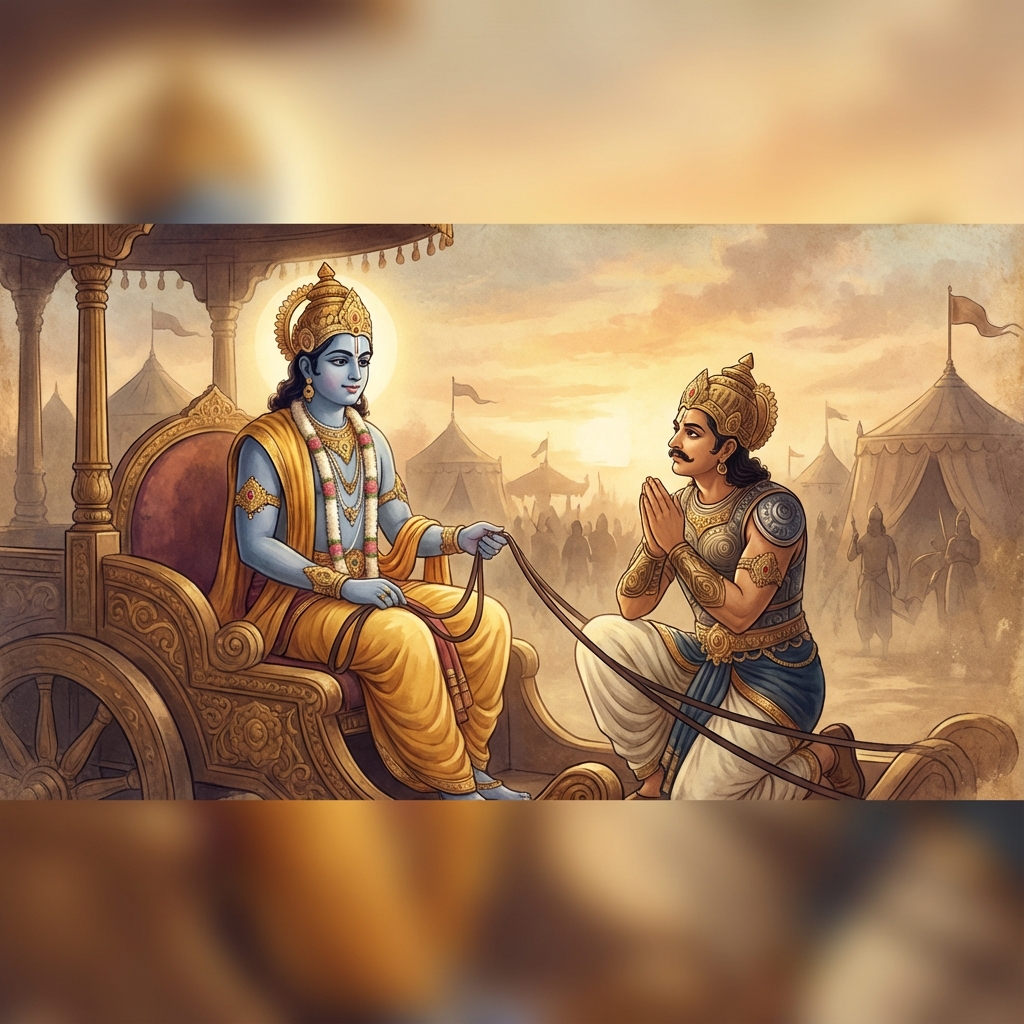
Chapter 1: Arjuna's Despair – The Crisis of Conscience
On the brink of a great confrontation, Arjuna stands in his chariot and surveys the battlefield of life before him. He is a leader facing an impossible moral dilemma: on one side, his duty to uphold justice and fulfill his responsibilities; on the other, the people he loves and respects are the very ones he must oppose. Seeing friends, teachers, and family among the ranks of the enemy, Arjuna is overwhelmed by grief, anxiety, and conflict. His hands tremble and his mind reels with cognitive dissonance – the stress of holding contradictory values. In that moment, Arjuna's courage collapses. He throws down his bow and declares "I will not fight," overcome by a profound crisis of conscience. This opening chapter vividly illustrates a universal human moment: when we freeze under the weight of a grave decision, our emotions paralyze us and we desperately question what is right.
Arjuna's despair is the necessary breakdown before a breakthrough – the kind of inner collapse that often precedes searching for deeper understanding.
Insight: Even the strongest of us can be shaken by moral conflict. Recognizing our vulnerability and confusion is the first step toward seeking wisdom.
Chapter 2: From Despair to Clarity – Rising to a Higher Reason
Arjuna, despondent, turns to Krishna for guidance. In secular terms, this is when reason and inner wisdom finally speak up to a mind clouded by fear. Krishna – Arjuna's charioteer and dear friend – now becomes the voice of rationality and stoic calm. He gently chastises Arjuna for his paralysis, urging him to "snap out" of his despair.
Firstly, Krishna helps Arjuna reframe the situation. He reminds Arjuna that life and death are natural processes – every person on that battlefield will die eventually, one way or another. This is a stark but rational perspective: rather than being immobilized by the fear of loss, Arjuna should consider the bigger picture. People live, people die, but what truly matters is living (and if necessary, dying) for a worthy principle.
Krishna's counsel zeroes in on the idea of duty and ethical action. Arjuna is a warrior not by blind chance, but because he stands for protecting his community's welfare. If he fails to act now, injustice will prevail. This isn't about personal gain or vengeance – it's about responsibility.
Importantly, Krishna introduces a key lesson: focus on your actions, not on the fruits of those actions. In modern terms, Arjuna should concentrate on doing the right thing without obsessing over success or failure, praise or blame. By relinquishing attachment to the outcome, he can act with a clear mind. "Be intent on action, not on the rewards," Krishna advises.
This principle is profoundly psychological: it frees one from paralyzing fear of failure and excessive desire for reward. Arjuna is to perform his duty because it is right, not because it guarantees victory or personal happiness. Adopting this attitude of equanimity – treating success and failure alike – will give him steadiness.
By the end of Chapter 2, Arjuna begins to emerge from despair. He understands that shrinking from his duty out of fear would be a betrayal of himself and others who depend on him.
Insight: When overwhelmed by a moral dilemma, broaden your perspective. Accept what you cannot change (like mortality) and focus on what you can – your own actions and principles. Do the right thing because it's right, not for reward or out of fear.
Chapter 3: The Ethic of Action – Duty as Selfless Service
With Arjuna's mindset shifting toward action, Chapter 3 delves deeper into ethics and responsibility. Arjuna wonders why he must fight at all – wouldn't it be better to renounce violence and avoid this conflict? Krishna's answer is clear: inaction is not a solution. In fact, inaction is impossible – doing nothing is itself a choice with consequences.
Every member of society has a role, and Arjuna's role (as a protector of his people) happens to involve this painful task. If individuals shirk their responsibilities, the whole system suffers. If Arjuna, the commander, refuses to fight against an aggressor, he would effectively allow injustice and chaos to take over.
Krishna explains that action done in the right spirit is far superior to withdrawal. He introduces the idea of "selfless service." If Arjuna fights not out of hatred but out of duty to protect society, his violence is not born of selfish desire but of necessity and righteousness.
Krishna describes the world as a kind of interconnected web of duties. Every profession and role contributes to the common good. A farmer grows food, a teacher educates, a protector upholds justice – all are needed. Thus, Krishna urges Arjuna (and us) to see work as a form of service rather than personal achievement.
This is often called karma-yoga – the yoga of action – which we can interpret as ethical action. One doesn't need to be in a temple to be spiritual; doing one's everyday job honestly and well, with a spirit of altruism, is equally noble.
Crucially, Krishna reiterates the importance of non-attachment while acting. Arjuna should fight with all his skill and strength, but without hatred, without lust for power, and without ego. In psychological terms, Krishna is teaching flow and focus – pour yourself into the task fully, but don't tie your ego to the result.
Insight: We all live within a network of mutual dependences. Fulfilling our responsibilities with a selfless attitude upholds society and cultivates personal integrity. Avoiding duty isn't true peace – it's a path to greater harm. Act, but act for the greater good, without ego.
Chapter 4: Wisdom in Action – The Value of Knowledge and Principles
Arjuna, now committed to action, still needs guidance on the wisdom behind these teachings. Chapter 4 introduces a more reflective tone: Krishna shares insight into how these principles are timeless and how knowledge informs righteous action.
One key idea Krishna expounds is the relationship between knowledge and action. Action without understanding can be blind or fanatic; understanding without action is impotent. So Arjuna must cultivate both. "Approach the wise, ask questions, and learn from them," Krishna advises. Ignorance is a major source of fear and doubt. By gaining true knowledge, Arjuna's confusion will disappear like darkness at dawn.
Another powerful concept is acting without ego, framing one's work as an offering to a higher good. Krishna uses the metaphor of yajna (sacrifice) – not as a literal ritual, but as any action done in a spirit of dedication. Some people sacrifice material possessions (charity), some sacrifice comfort (through discipline), some sacrifice ignorance for knowledge (study and teaching). These are all noble actions that require giving up something for a greater cause.
Krishna also touches on a subtle insight: what truly defines an action's morality is the intention and awareness behind it. He famously says that a wise person sees action in inaction and inaction in action. Someone might appear outwardly inactive but if their mind is full of selfish calculations, that is harmful "action." Conversely, someone might be very active but inwardly detached and peaceful, thus maintaining inner stillness even as they work.
By the end of Chapter 4, Arjuna sees his duty not as a burden of violence, but as part of a larger tapestry of meaning. He understands that his personal actions can be elevated to something impersonal and noble when guided by wisdom.
Insight: Knowledge and action must go hand in hand. Learn continuously and understand the deeper reasons behind your duty. When you act, offer your actions to a principle or cause you believe in – this transforms work into a form of devotion to the greater good and keeps your ego in check.
Chapter 5: True Renunciation – Freedom Through Detachment
At this stage, Arjuna grapples with a practical question: is it better to renounce the world and live in contemplation, or to act within the world? Krishna's answer brings Arjuna to a nuanced understanding: True renunciation isn't about physically withdrawing from duties, but about mentally letting go of selfish attachments.
Krishna contrasts two types of people: the false renouncer and the true renouncer. The false renouncer might refuse to do his duty, claiming to seek peace, but internally he may still be attached – perhaps to comfort, or to the image of being "spiritual." This is not freedom; it's self-deception. The true renouncer, by contrast, could be very active in the world – leading, creating, working – yet because he's given up attachment to personal gain, he remains at peace.
In modern terms, Krishna is advocating for a mindset of detachment. It's not our outer lifestyle (monk vs professional) that determines our tranquility, but our inner attitude. If we drop the ego and obsessive desires, we can find inner calm even while fulfilling busy duties.
Another important teaching is seeing unity in all beings. Krishna says an enlightened person sees everyone with an equal eye – whether it's a respected scholar, a humble laborer, or even a traditionally "low" or outcast person, he recognizes the same fundamental value in each. This is a call to universal humanism. For us today, this teaching encourages looking past external labels (race, class, nationality) to recognize a common humanity.
As Arjuna absorbs this, he's shown an image of the ideal person who has attained inner equilibrium: someone who is not elated by pleasure nor disturbed by pain, who is free from jealousy, and remains calm in success or failure. This is essentially a portrait of emotional intelligence and resilience.
Insight: Real peace doesn't come from running away – it comes from letting go of ego and desire while staying engaged in life. Do your work, play your part, but free your mind from the constant "What's in it for me?" Only then can you be active and still remain serene.
Chapter 6: Self-Mastery – The Discipline of Meditation and Mind
Now that Arjuna knows the what and why of his duty, Krishna turns to the how. Chapter 6 is all about self-mastery – it teaches Arjuna practical methods to gain control over his turbulent mind and emotions. In modern terms, this chapter could be titled "Mental Health and Meditation."
Krishna observes that the mind can be both a friend and an enemy. When under control, it's our best friend; when uncontrolled, it's our worst enemy. So how can one tame the mind? Krishna's answer is regular discipline and meditation. He instructs Arjuna to practice focusing his mind through breath and concentration – very much like a meditation posture.
Arjuna is frank about his doubts – he interjects that the mind is "as restless as the wind." How can anyone control it? Krishna acknowledges it's difficult, but achievable with practice (abhyasa) and detachment (vairagya). These are the twin pillars of mental training: consistent practice and a habit of stepping back from one's thoughts and feelings.
Besides formal meditation, Krishna emphasizes a balanced lifestyle. "Yoga is not for one who eats too much or too little, nor for one who sleeps too much or too little." In secular terms, moderation is key to mental well-being. A healthy body and regular habits support a steady mind.
Krishna paints a picture of the outcome: one who has mastered their mind "is tranquil in heat and cold, in pleasure and pain, in honor and dishonor." Such a person is like a lamp in a windless place, steady and unflickering.
Krishna also encourages Arjuna with compassion: even if you falter in this practice, no effort is wasted. Every bit of progress in self-mastery will stay with you. The path of self-improvement is gradual, and any step forward is valuable.
Insight: Mastering oneself is the greatest victory. Through practices like meditation, mindfulness, and moderation in daily habits, one can cultivate a mind that stays calm and focused amid turmoil. A well-trained mind serves you; an untrained mind sabotages you. Be patient and consistent in self-discipline – every bit of practice counts.
Continue Reading
This concludes Part 1 of our secular interpretation of the Bhagavad Gita. Arjuna has moved from paralysis to understanding, gaining the foundation of ethical action, selfless service, and mental discipline.
Next: Part 2: Development (Chapters 7-12) →
In Part 2, we explore broadening vision, reflections on mortality, the power of devotion, and the overwhelming cosmic vision that transforms Arjuna completely.
This is part of my philosophical blog series. Read more articles →